

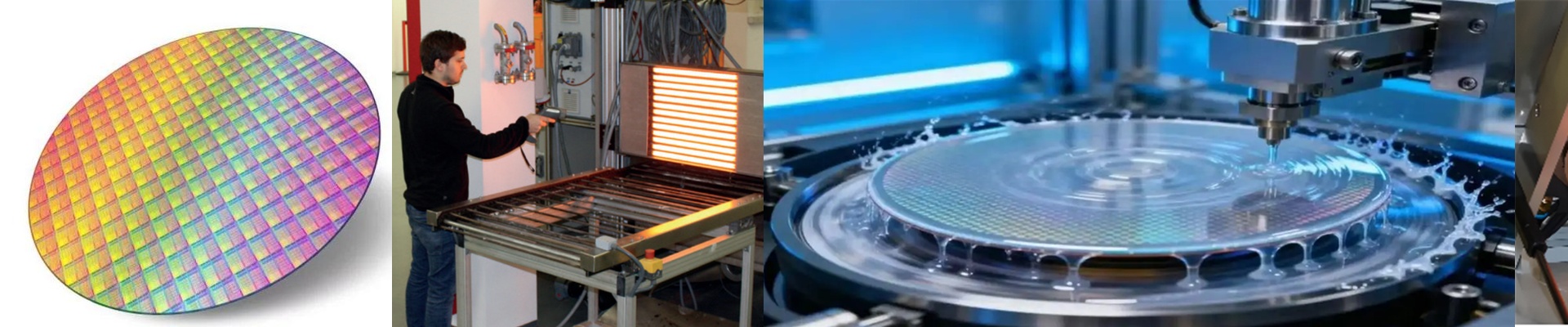
Out on the fab floor, tool repair isn’t something you schedule. It’s a scramble to keep the line moving. When a coater/track hotplate, anneal module, or probe station heater goes down, you need heat that comes back fast, settles immediately, and holds tight uniformity—without adding particles. What actually matters under the hood We build short-wave infrared (NIR) heaters for fab tool repair, tuned for a quick ramp to setpoint and repeatable wafer-level thermal uniformity. The quartz emitter geometry and reflector array are set up to cut hot spots and edge roll-off, and the closed-loop control keeps repeatability within ±0.1°C across the active zone. Cleanroom behavior is engineered in: low outgassing materials, Class 1–100 compliant construction, and a particle-controlled assembly process that keeps contamination out of photoresist processing. For process integrity, the heater holds stable, drift-controlled temperature through photoresist soft bake and hard bake profiles—so linewidth control and defect budgets don’t take a hit. Why this works in a repair bay In a repair bay, the scoreboard is uptime and yield risk. Fast stabilization means a shorter qualification after replacement, and consistent repeatability means less rework and scrap. You also save energy because NIR heats the target directly, not the surrounding hardware, and the emitter life stretches out replacement intervals. The design is built as a validated equivalent to OEM thermal specs, so you can swap it in without re-qualifying the entire tool—keeping lithography and track process windows intact while restoring performance. The practical details you can’t skip Installation comes down to matching the mechanical envelope, mounting interface, and sensor positioning to the original module. If alignment is off, uniformity suffers. Double-check voltage, connector type, and clearance against the tool’s service drawings. In high-humidity environments, give it time to warm up before process exposure so surface temperature stabilizes and you avoid condensation-induced drift.