

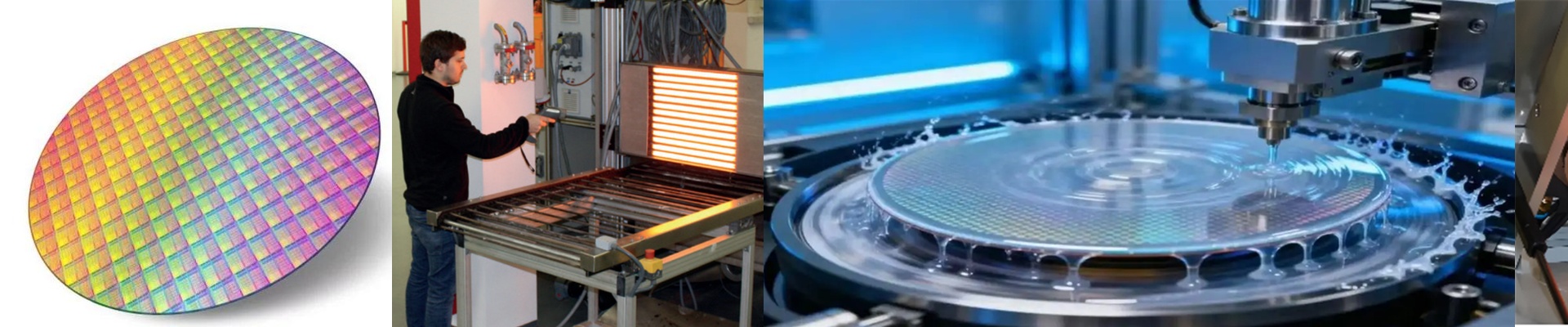
On the floor, that temperature curve isn’t a guideline. It’s the process. A soft bake that drifts even a hair changes how the photoresist behaves—CD control slips, the sidewall profile goes sideways, and yield goes with it. A hard bake that isn’t uniform across the wafer? That invites scum, poor adhesion, and a pile of rejects that you’ll be chasing for days. In lithography and the photoresist thermal steps, the heater has one job: deliver repeatable heat, on command, without fouling the environment. When a heater fails, it rarely puts on a show. No smoke. Just drift. Particle events. Excursions that show up out of nowhere and force rework, scrap, and a mad scramble to re-stabilize the thermal budget. We built Teflon wire for semiconductor heaters because the wiring inside matters as much as the element. It has to carry current cleanly, survive high temperature, and do it in cleanroom air without adding a single molecule you can’t account for.
What actually matters, technically
Semiconductor thermal systems don’t cut you any slack on materials. The internal wiring has to live through repeated thermal cycling, keep insulation integrity intact, and keep contamination at zero. Teflon (PTFE) is the choice because it’s stable electrically and chemically. In a heater that sees high operating temperatures over and over, PTFE doesn’t outgas into the chamber, and it doesn’t shed particles when you flex it during maintenance. The payoff is predictable chamber chemistry and particle counts that stay inside the cleanroom envelope. The wire geometry is matched to the heater’s power and voltage. In a typical semiconductor heater application, we size the conductor to minimize voltage drop along the internal path—because voltage drop translates straight into temperature error at the wafer plane. Cross-section and insulation thickness are chosen so the electrical path stays clean and mechanically stable, even as the heater cycles from idle to full load, again and again. And the termination? It’s part of the thermal system, not an afterthought. High-temperature, low-outgassing terminations keep contact resistance stable through thermal soak and cooldown. If terminations wobble, you get local hot spots—and those turn into non-uniformity across the wafer. In practice, the heater behaves like a calibrated instrument, not a variable. You command a temperature, you get that temperature, shift after shift.
Why this works in real photoresist processing
Photoresist processing—soft bake, hard bake, and the surrounding thermal steps—lives or dies on repeatability. The wafer sees a thermal budget that has to land in the same place, lot after lot. When the internal wiring is matched to the heater’s thermal profile, the system stays steady. We’ve seen field data where the heater holds tighter thermal uniformity across the wafer, excursions staying within a narrow band. That isn’t cosmetic. It cuts scrap, reduces rework, and shortens qualification cycles. Cleanroom compatibility is non-negotiable. Teflon wire supports low particle generation, and that matters because every particle that makes it into the process zone becomes a potential defect. In Class 1–100 environments, the wiring can’t be a hidden contamination source. PTFE’s inertness keeps the heater from becoming one. Reliability shows up as uptime, not slogans. Heaters built this way are meant to run 24/7, with thermal cycling that doesn’t degrade insulation or create intermittent connections. Fewer unplanned stops mean fewer line interruptions, fewer alarms, and fewer interventions that introduce human-induced variability. The gains are direct.
- Tighter thermal control keeps photoresist bake consistent, which supports CD control and stable profiles.
- Lower particle generation reduces yield loss from microcontamination.
- Less frequent maintenance cuts spare parts usage and labor hours.
- Stable electrical performance keeps energy use predictable, so you’re not wasting margin. That’s how you stop chasing excursions and start controlling them.
What you need to know
Teflon wire for semiconductor heaters is engineered for high temperature and low contamination, but it still needs the right mechanical treatment. Installation matters. PTFE is tough, but it doesn’t like sharp bends or edge loading. Keep bend radii controlled, avoid sharp edges, and secure the wire so vibration and thermal expansion don’t cause abrasion. A small nick in the insulation can turn into a particle event once thermal stress hits. Compatibility has to be checked at the system level. Match the wire to the heater’s power, voltage, and termination style. Confirm the full assembly—wire, termination, and connector—can survive the maximum soak temperature and the fastest allowed ramp rates without losing insulation or contact integrity. Plan for service access. Even the cleanest heater design will need maintenance. Route the wiring so it can be inspected and replaced without introducing new contamination, and specify procedures that keep particle generation at zero during replacement. If you’re running at the edge on temperature and power, talk to us early. We can tailor conductor sizing and insulation thickness to your specific thermal profile, so the heater stays within spec across the entire operating window. In semiconductor manufacturing, heat isn’t just heat. It’s control. Teflon wire for semiconductor heaters gives you that control—quiet, repeatable, and clean.