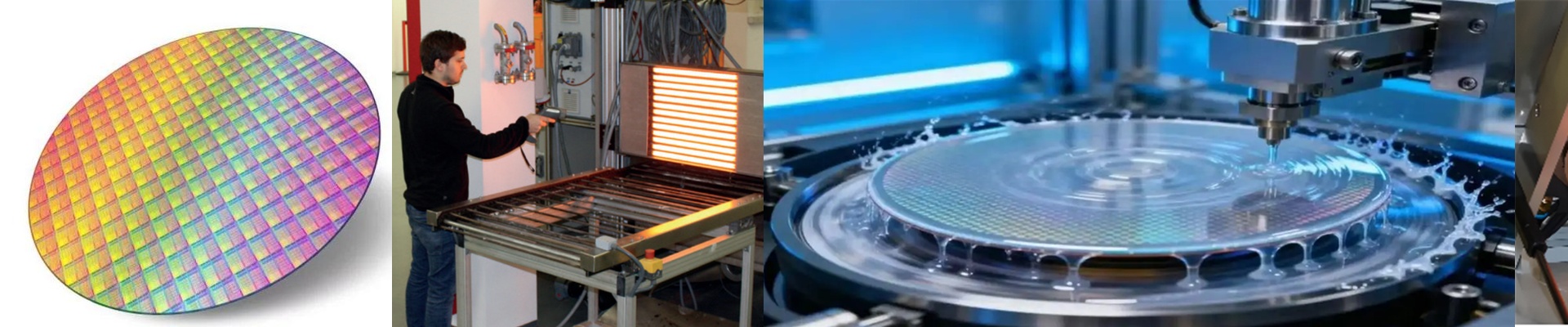
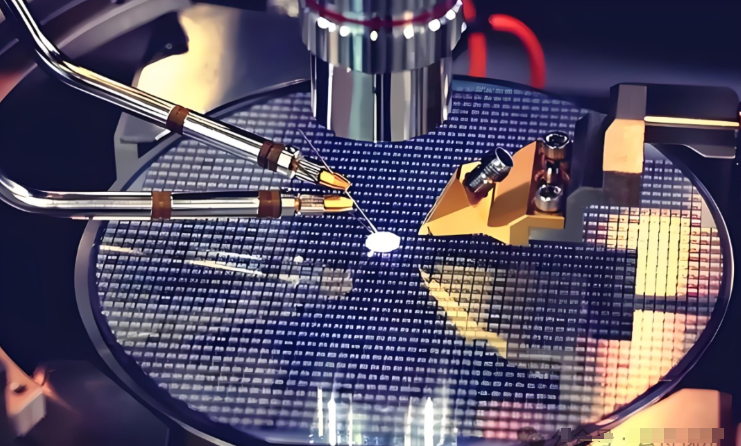
On the track, the substrate moves with that steady, predictable rhythm—quiet and repeatable. Photoresist goes down, edge bead is stripped, and the wafer slides into the bake. This is where you lock in the thermal budget: soft bake to pull out the solvent, hard bake to lock adhesion and keep development behavior stable. With flexible substrates, you don’t get the same forgiveness you have on glass. Temperature nonuniformity isn’t just a line-width offset. It loads stress into the stack, invites delamination, and kicks up particles that can shadow the whole film. If the bake lamp isn’t performing, you blow your defect budget before the reticle even steps.
What matters under the hood
We built the flexible display drying lamp around one target: wafer-level thermal uniformity of ±0.1°C across the active bake zone. You get there with a controlled radiant spectrum tuned to how the photoresist actually responds to heat—not by throwing wattage at it. The module uses short-wave quartz halogen emitters, reflectors engineered to shape the profile, and closed-loop pyrometry at multiple points. That way the controller can compensate for lamp aging, line voltage ripple, and emissivity shifts across the substrate. Bake profile repeatability lands at ±0.2°C setpoint-to-setpoint, shift-to-shift. Ramp rates hold within ±1% of target, so you drive off solvent consistently without skinning the resist. The same chamber handles both soft bake and hard bake, and recipe-driven zone balancing keeps edge-to-center bias inside spec. Cleanroom compatibility is a functional requirement, not a cosmetic one. The housing is built for Class 1–100 environments: external surfaces are electropolished, and HEPA-filtered air purge keeps particle generation flat during operation. The hot zone is isolated from the clean air path, and the lamp-to-substrate interface is sealed so outgassing doesn’t land on the resist. Zero particle generation is measured, not assumed. Reliability comes down to uptime. The emitter array runs 24/7 with scheduled maintenance windows, and the design takes repeated thermal cycling without microcracking or output drift. We’ve seen units run 5,000+ hours with less than 5% output drop, and the modular setup lets you swap lamps in minutes without breaking the cleanroom envelope.
Why this works in flexible display fabs
Flexible fabs run thin substrates—PI, thin metal foils, barrier stacks—where thermal gradients turn straight into mechanical stress. A 0.5°C edge-to-center delta can push the critical dimension across spec and leave you fighting resist scum at the perimeter. Our drying lamp holds the bake surface within ±0.1°C, so the resist sees the same profile whether the substrate is 150 mm or 300 mm, and whether the lot is baking at 120°C or 150°C. That kind of consistency cuts rework and scrap. Photoresist yield is sensitive to temperature history; uniform bakes mean fewer reworks, fewer scrapped layers, and fewer excursions that force a line stop. In lithography, the track bake sets the stage for the scanner. When the bake is repeatable, exposure latitude opens up, and focus-exposure matrices stop drifting lot to lot. Energy use drops because control is tight. The lamp delivers the required energy density, and the controller adjusts in real time as thermal load changes. No idling at full power. No overshoot at startup. The system hits setpoint fast and sits there, which lowers peak demand and stabilizes the fab’s thermal load. Downtime is expensive, even in small chunks. The lamp is designed for continuous operation, with redundant sensor feedback and hot-swappable emitter modules. When a lamp hits end-of-life, the system rebalances the remaining zones and keeps the line running until the scheduled break. Unplanned stops for lamp replacement go down.
What you need to plan for
The lamp integrates with standard track interfaces and SECS/GEM recipes, but it isn’t plug-and-play without a plan. The bake chamber needs a dedicated exhaust path and a clean dry air supply matched to the tool’s pressure profile. The utility footprint is compact, but the power feed has to be clean. If plant power is noisy, line ripple shows up as a temperature deviation in the controller. A dedicated line—or a filter—is worth it. Substrate emissivity varies across flexible display stacks, and the pyrometers need a clean line of sight to the bake surface. If the stack includes highly reflective layers, we tune the sensing wavelength and bake in a calibration offset. It’s a short setup step, but it has to be done once, and done right. There is one trade-off: the tighter the uniformity, the closer the lamp sits to the substrate, and the more the system depends on mechanical tolerances. You need stable stage repeatability and consistent substrate flatness. In return, the bake doesn’t chase geometry. If your fab runs multiple substrate formats, budget time for initial recipe tuning. Once calibrated, the lamp holds the profile across formats without retuning. On the line, the substrate moves through, and it comes out with the resist cured to the same spec as the last lot. No edge scum. No stress marks. The thermal budget stays controlled, and yield stays protected. That’s the point of precision drying in a flexible display fab.